I've spent years in the mining world, and one of the most exciting moments is finding that first glint of gold. But finding something that looks like gold doesn't mean it is. You need to test it.
Testing for gold ore[^1] involves a series of steps, starting with visual inspection and physical property tests, then moving to more definitive chemical analyses like fire assay or atomic absorption spectroscopy (AAS), and finally, potentially, specialized geological assessments to determine economic viability.
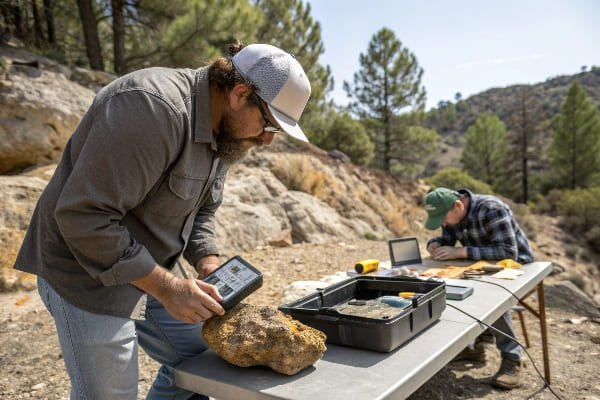
Discovering potential gold ore is just the beginning. The real challenge is confirming its presence and economic value. Let me walk you through the process, from simple field tests to sophisticated lab analyses, to help you understand how prospectors and companies confirm gold.
Can You Identify Gold Ore Just by Looking at It?
When I first started prospecting, every shiny piece of metal looked like gold to me. I quickly learned that visual identification is only the very first step, and it's highly unreliable on its own.
While a metallic luster and golden-yellow color are key visual indicators, you cannot definitively identify gold ore just by looking at it. Many other minerals, such as pyrite (fool's gold), chalcopyrite[^2], and even mica, can mimic gold's appearance, often leading to false positives without further testing.
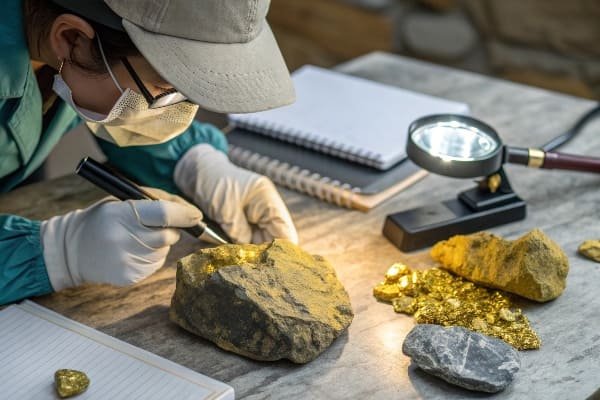
Common Gold Look-Alikes and Distinguishing Features
It's easy to get excited, but here’s how you can start to tell the difference even before more definitive tests.
| Characteristic | Gold | Pyrite (Fool's Gold) | Chalcopyrite | Mica (Biotite) |
|---|---|---|---|---|
| Color | Bright, rich golden yellow | Brassy yellow, metallic | Brassy yellow, often with green or purple tarnish | Brown to black, flaky, metallic sheen |
| Luster | Bright metallic, does not tarnish | Bright metallic, can tarnish | Metallic | Pearly to submetallic |
| Hardness | Very soft (2.5-3 on Mohs scale), can be scratched by a fingernail | Hard (6-6.5), cannot be scratched by a fingernail or knife | Medium (3.5-4), harder than a copper penny | Very soft (2.5-3), can be scratched by a fingernail |
| Malleability | Malleable (can be hammered flat), ductile (can be drawn into wire) | Brittle, crumbles when hammered | Brittle, crumbles when hammered | Flexible and elastic, splits into thin sheets |
| Crystal Shape | Irregular nuggets, flakes, or dendritic (tree-like) patterns | Cubic crystals, sometimes pyritohedrons (12-sided) | Tetragonal crystals, typically massive or granular | Flat, hexagonal sheets or flakes |
| Streak | Golden yellow when rubbed on a streak plate | Greenish-black to brownish-black streak | Greenish-black streak | White or colorless streak |
I've personally picked up countless shiny specks, only to find they were mica flakes. The key is to remember that gold is quite soft and will deform rather than shatter. Pyrite, on the other hand, is brittle and will break. The streak test is also incredibly helpful. Real gold will always leave a gold streak, while its imposters will leave a dark or colorless mark. While you can't guarantee gold by just looking, these simple observations are the crucial first filter to avoid wasting time on false leads.
What Simple Field Tests Can Confirm Gold?
After a visual check, the next step in the field is to get physical. These tests are quick, don't require fancy equipment, and can save you a trip to the lab if you've found "fool's gold."
Several simple field tests can help confirm the presence of gold, leveraging its unique physical properties. These include the scratch test (gold is soft), the malleability test (gold bends, doesn't break), the specific gravity test (gold is very dense), and the pan test (gold separates easily in water due to density).
Performing Field Tests for Initial Confirmation
These tests are your best friends in the field. They are essential for a quick, preliminary confirmation before more involved analysis.
| Test Name | Procedure | Expected Result for Gold | Common Misidentification & How to Differentiate |
|---|---|---|---|
| Hardness/Scratch Test | Use a steel knife blade or a copper penny to try to scratch the sample. | Gold is soft (2.5-3 Mohs) and will be scratched by a copper penny (3.5) or a steel knife (5.5). Pyrite won't scratch easily. | Pyrite: Harder, won't scratch. Mica: Softer, flakes off instead of scratching. |
| Malleability Test | Place the sample on a hard surface and strike it with a hammer or rock. | Gold is malleable; it will flatten or deform like lead without shattering or crumbling. | Pyrite/Chalcopyrite[^2]: Will shatter, break, or crumble into powder. |
| Streak Test | Rub the sample firmly against an unglazed ceramic streak plate or the back of a toilet bowl lid. | Gold will leave a bright, metallic golden yellow streak. | Pyrite: Greenish-black streak. Chalcopyrite: Greenish-black streak. |
| Specific Gravity Test | This is a density test. Feel the weight of the sample in your hand, then, if possible, compare its weight to a similar sized rock. For more precision, use a weighing scale and water displacement. | Gold is extremely dense (19.3 g/cm³), feeling remarkably heavy for its size. Even a small piece will feel surprisingly heavy. | All Look-Alikes: Significantly lighter than gold of the same size. |
| Pan Test | Crush the sample and pan it in a gold pan with water. | Gold, being very dense, will settle quickly to the bottom of the pan and remain there, separating from lighter materials. | Mica/Light Minerals: Will wash away easily with the lighter material. |
I've had countless experiences where a quick streak test[^3] on a piece of slate immediately ruled out pyrite. The pan test is also incredibly effective, as gold's density truly makes it stand out. While these tests are good indicators, they aren't quantitative. They won’t tell you the percentage of gold, only whether it's likely present. However, successfully passing these simple field tests is a very strong reason to move to the next stage of laboratory analysis[^4].
What Laboratory Analysis Methods are Used for Gold Ore?
Once you’ve done your field tests, and you're confident you might have something, you need to go to the lab. This is where you get definitive answers about how much gold is actually there.
Laboratory analysis for gold ore typically involves highly precise techniques to quantify gold content, even at trace levels. The most common and reliable methods are fire assay, which is considered the "gold standard" for its accuracy, and atomic absorption spectroscopy (AAS) or inductively coupled plasma mass spectrometry[^5] (ICP-MS) for lower detection limits and multi-element analysis.
Delving into Analytical Techniques for Gold
These lab methods are complex, but understanding broadly how they work helps when interpreting reports.
| Method | Principle | Advantages | Disadvantages | Ideal Use Case |
|---|---|---|---|---|
| Fire Assay (Fusion) | Sample is crushed, mixed with fluxes (lead oxide, borax), melted at high temperature. Gold (and silver) collect in a lead button, which is then cupelled to separate precious metals. | Extremely accurate and reliable, considered the industry standard. Removes matrix interferences. No practical upper limit for gold concentration. | Time-consuming, destructive, requires high temperatures and skilled technicians. Cannot analyze other elements easily. | Definitive quantification of high-grade gold samples; final confirmation of economic ore; umpire analysis. |
| Atomic Absorption Spectroscopy (AAS) | After acid dissolution, a liquid sample is atomized in a flame. Light from a specific lamp passes through, and the absorption by gold atoms measures its concentration. | Relatively quick, good for a range of concentrations. Can analyze multiple elements (if different lamps/settings used). | Less sensitive than ICP-MS. Requires thorough dissolution of the sample. Susceptible to matrix interferences. | Routine analysis of medium to low-grade gold samples; environmental gold monitoring; exploration geochemistry. |
| Inductively Coupled Plasma - Mass Spectrometry (ICP-MS) | Sample dissolved in acid, introduced into an argon plasma. Atoms are ionized, separated by mass-to-charge ratio, and detected. | Extremely sensitive, excellent detection limits for trace gold and many other elements simultaneously. Fast multi-element analysis. | Expensive equipment, complex operation, prone to matrix effects if not handled properly. | Ultra-trace gold analysis in exploration; multi-element geochemical surveys; environmental monitoring. |
| Cyanide Leaching (Bottle Roll Test) | Crushed sample is agitated in a cyanide solution, dissolving gold. The gold-rich solution is then analyzed. | Simulates actual extraction process, provides insight into gold recoverability. | Toxic reagents, requires careful handling. Only for specific process-related questions, not general assay. | Determining the amenability of an ore to cyanide extraction; pre-feasibility studies for processing. |
I've sent thousands of samples for fire assay. It’s comforting to know that even if the grade is low, the fire assay reports are incredibly precise. For exploration, however, ICP-MS is invaluable. I once had a project where initial fire assays showed very little gold, but ICP-MS revealed subtle trace element anomalies, guiding us to a significant deposit just a few meters away. The most crucial part of any lab analysis is proper sample preparation. The sample must be truly representative of the ore, and meticulously pulverized to ensure homogenization, otherwise, even the best lab test will give a misleading result. Always use a certified lab – their accreditation ensures quality control and reliable results.
Conclusion
From visual hints to precise lab reports, testing for gold ore requires various steps. Start with simple field tests and always rely on specialized lab analysis for the final word on what you've found.
---

[^1]: Understanding the methods to test for gold ore can help you confirm its presence and economic value.
[^2]: Distinguishing pyrite from gold is crucial to avoid false positives; explore the key differences.
[^3]: The streak test is a simple yet effective method to identify gold; find out how to do it right.
[^4]: Understanding various lab methods can improve your testing accuracy; discover the options available.
[^5]: ICP-MS is a powerful tool for trace gold analysis; discover its advantages and applications.