Meta Description: Discover how modern vibrating screen technology is transforming gold mining operations. Learn about high-frequency dewatering screens, energy-efficient classification, and sustainable mineral processing solutions for maximum gold recovery.
Keywords: vibrating screen, gold mining, gold recovery, high-frequency screen, dewatering screen, sustainable mining, mineral processing, gold ore classification, tailings management, screening efficiency
Introduction
In the ever-evolving landscape of gold mining, the ability to efficiently separate valuable minerals from waste material directly determines operational profitability and environmental footprint. As gold deposits become deeper, lower in grade, and more challenging to access, processing equipment must evolve accordingly. Among the most critical yet often overlooked components in a gold processing plant is the vibrating screen—a machine that serves as the gatekeeper of particle size classification, dewatering, and material flow optimization. This article explores how modern vibrating screen technologies are not only boosting gold recovery rates but also aligning the industry with global sustainability mandates.
The Role of Vibrating Screens in Gold Processing
Vibrating screens are indispensable assets in mineral processing circuits, employed for efficient particle size separation through high-performance screening-37. In a typical gold processing plant, vibrating screens perform multiple critical functions:
-
Primary Classification: After crushing, screens separate coarse material for recirculation to crushers while allowing fine particles to proceed to grinding circuits.
-
Slurry Cleaning: Downstream of cyclone overflow, screens remove trash and oversize particles before leaching processes.
-
Dewatering: High-frequency screens remove excess moisture from concentrates and tailings, reducing water consumption and improving downstream efficiency.
-
Carbon Safety: In carbon-in-pulp (CIP) and carbon-in-leach (CIL) circuits, screens retain activated carbon while allowing gold-laden solution to pass through.
The global vibrating screen market reflects the growing demand for such equipment. Valued at approximately USD 3.1 billion in 2025, the market is projected to reach USD 4.8 billion by 2032, growing at a compound annual growth rate (CAGR) of 6.3%–. This growth is fueled by ongoing mining activities and the need for more efficient material processing solutions worldwide–.
High-Frequency Vibrating Screens: A Game-Changer for Fine Gold Recovery
Traditional vibrating screens operating at low frequencies have long struggled with issues such as screen blinding—where fine particles clog apertures—and excessive structural vibration that necessitates heavy steel supports-11. The introduction of high-frequency, low-amplitude vibrating screens has resolved the majority of these challenges, offering:
-
Elimination of Screen Blinding: High-frequency excitation continuously clears screen apertures, maintaining open area and consistent throughput.
-
Enhanced Dewatering: These screens significantly increase dewatering effectiveness on fine material.
-
Higher Separation Probability: The combination of high frequency and low amplitude increases the probability of coarse and fines separation, contributing to higher overall screening efficiency.
-
Smaller Footprint: Reduced structural vibration requirements enable lighter support structures and more compact plant layouts-11.
For fine particle applications—precisely where gold recovery faces its greatest challenges—high-frequency vibrating screens have emerged as the optimal choice-37.
Energy Efficiency and Sustainability: The New Imperative
Environmental, social, and governance (ESG) expectations are fundamentally reshaping mineral processing operations worldwide-20. Investors, regulators, and local communities increasingly demand transparency, reduced emissions, lower water usage, and accountable land rehabilitation practices. Vibrating screens sit at the center of this transformation.
The smart screening concept focuses energy precisely on the mineral processing payload, with the “live” deck weight typically no more than two to three times the payload weight—dramatically reducing parasitic energy consumption–. Advanced features enabling this efficiency include:
-
Variable Frequency Drives (VFDs): Matching motor speed with actual material load, these devices alone can reduce screen energy consumption by 15 to 30 percent–.
-
Wear-Resistant Screen Media: Polyurethane panels significantly extend service life while reducing maintenance downtime.
-
IoT-Enabled Monitoring: Wireless sensor systems continuously track screen health and performance, enabling predictive maintenance and optimal operation–.
By combining energy-efficient motors, smart maintenance protocols, optimized screen media, and IoT monitoring, mining plants can realistically cut vibrating screen operating costs by 30 percent or more–.
Retrofitting: Extending Equipment Life While Reducing Carbon Footprint
One of the most immediate and impactful ways to improve sustainability in gold mining is to extend the life of existing equipment through retrofitting. This approach significantly reduces the need for new manufacturing, which in turn lowers carbon emissions and resource consumption-20.
Many gold operations continue to run outdated screen models that consume excessive energy and water. Retrofitting these machines with advanced technology components, high-performing screen media, and efficient washing systems can dramatically improve performance—often at less than half the cost of purchasing new equipment-20.
The retrofit process typically begins with a site assessment where a screening specialist evaluates the machine‘s structural integrity and identifies rebuildable or replaceable components. High-performance parts—such as polyurethane screen panels, modular decks, or energy-efficient motors—are then installed. Certified technicians may use vibration analysis tools to ensure the refurbished machine operates within optimal parameters. Remarkably, machines that are decades old—up to 80 years in some cases—have been successfully refurbished and returned to service, performing as efficiently as newer models-20.
Industry Innovation: High-Capacity Screening Solutions
Leading manufacturers have responded to industry demands with innovative products specifically designed for gold processing. Derrick Corporation, for instance, has developed high-capacity screening solutions that allow gold plants to replace traditional hydrocyclones in grinding circuits. According to Garth Hay, Derrick‘s general manager of mining, “A Derrick Stack Sizer can replace the hydrocyclones in a grinding circuit, resulting in greater recovery at reduced power consumption per tonne.” By replacing old hydrocyclone technology with modern high-frequency vibrating screens, overall plant capacity can increase by 20 to 50 percent-27.
The company‘s G-Vault interstage screen represents another significant advancement. Featuring tapered openings and abrasion-resistant properties, the G-Vault prevents screen blinding, delivers higher throughput, extends operational life, and requires less maintenance—all contributing to more efficient gold recovery. Once installed, the G-Vault can operate for approximately six months before requiring replacement, while other comparable solutions may need weekly maintenance-27.
Derrick machines provide superior performance in a smaller footprint, offering a substantial advancement for gold plants worldwide-27.
China‘s Contribution to Green Gold Mining
China has made notable strides in sustainable gold mining technologies. Changtai Mining Company recently received the Second Prize for Scientific and Technological Progress at the Third China Green Mine International Annual Conference for its intelligent ore-sorting technology. This innovation integrates intelligent recognition algorithms with photoelectric detection to achieve precise identification and efficient sorting of gold-bearing waste rock. By lowering the economic utilization grade of gold from the traditional 0.6 g/t to just 0.2 g/t, the technology transforms previously discarded “waste” into valuable resources, effectively expanding gold resource reserves–.
This advancement aligns with broader industry trends. Research presented at the XXXI International Mineral Processing Congress indicates that sustainable green-mining schemes are proving effective in improving gold extraction from low-grade refractory ores, supporting progress toward a carbon-neutral society–.
Tailings Management and Water Conservation
Water management represents one of the mining industry‘s most pressing environmental challenges. Dewatering screens have emerged as essential tools for reducing tailings moisture content—often achieving levels below 15 to 20 percent—enabling dry stacking and minimizing water consumption–.
Water-recycling vibrating screens now integrate traditional gravity separation technology with modern water recycling systems, placing efficiency, environmental protection, and energy conservation at their core. These systems completely solve water consumption issues associated with mineral processing, making them ideal for energy-saving and emission-reduction upgrades at mining enterprises–.
Choosing the Right Vibrating Screen for Gold Processing
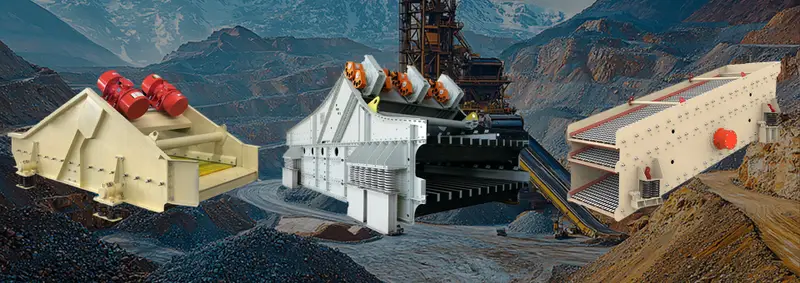
Selecting the appropriate screen type depends on specific application requirements:
| Screen Type | Best Application in Gold Processing |
|---|---|
| High-Frequency Screen | Fine particle classification, gold tailings recovery, lithium concentrate classification |
| Circular Motion Screen | Pre-screening and classification of coarse particles, alluvial gold operations |
| Linear Motion Screen | Dewatering, desliming, medium-density separation |
| Elliptical Motion Screen | Processing sticky gold ores, balancing throughput with efficiency |
For lithium and gold fine particles specifically, high-frequency vibrating screens consistently deliver superior results-37.
Conclusion: The Future of Gold Screening
As the gold mining industry navigates the dual pressures of declining ore grades and rising ESG expectations, vibrating screen technology will continue to play an increasingly strategic role. The integration of high-frequency excitation, energy-efficient drives, IoT monitoring, and sustainable retrofitting practices is transforming screens from simple classification devices into sophisticated tools for operational excellence.
Whether through replacing outdated hydrocyclones, retrofitting legacy equipment to extend service life, or implementing water-recycling screen systems, modern vibrating screen solutions offer gold miners a clear path forward: higher recovery rates, lower operating costs, and a smaller environmental footprint.
For mining engineers, plant managers, and procurement professionals seeking to optimize their gold processing operations, investing in advanced vibrating screen technology is no longer optional—it is essential for remaining competitive in an industry where every tonne of ore must deliver maximum value with minimum impact.
Sources:
-
Benefits of high frequency vibrating screen in gold processing plant, World Gold 2019 Conference Proceedings-11
-
Sustainable Strategies In Mining, Global Mining Review, November 2025-20
-
A golden process, Australian Mining, August 2023-27
-
What Are Vibrating Screens? A Practical Guide for Mining & Mineral Processing, Xinhai Mining, February 2026-37
-
Changtai Mining Company wins science and technology progress award, sdqy.dzwww.com, January 2026–
-
5 Ways to Reduce Vibrating Screen Costs by 30%, 2025–
-
XXXI International Mineral Processing Congress 2024 Proceedings