In modern mineral processing, coal washing, metallurgy, building materials, and chemical industries, screening operations are a critical link for material classification, dewatering, and medium recovery. Their efficiency directly impacts final product quality, production capacity, and overall economic benefits. Among various screening equipment, the Banana Screen (also known as a multi-slope screen or curved screen) has become the preferred choice for high-capacity, fine material screening applications due to its unique design and exceptional performance. This article provides an in-depth analysis of the core advantages of Banana Screens.
1. Namesake and Working Principle: The Mechanical Intelligence of a Non-Traditional Deck
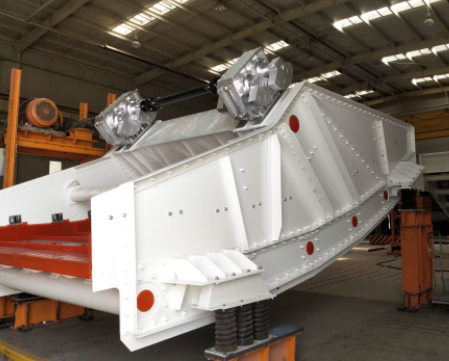
The Banana Screen gets its name because its screen box side profile resembles a bunch of bananas. Its most notable feature is the use of multiple decks with different inclination angles combined. Typically, the feed end has a steeper angle (e.g., 25°-35°), the middle section transitions gradually, and the discharge end has a shallower angle (near horizontal, e.g., 0°-5°). This non-traditional design is not for aesthetics but is based on the advanced theory of “Constant Bed Thickness” screening.
Traditional Horizontal Screen: The material bed moves slowly on the deck, the layer is thick, and fine particles need to penetrate the entire bed to reach the screen surface,容易造成堵塞 (easily causing clogging) and resulting in low screening efficiency.
Banana Screen:
Steep-angle Feed Section: The rapidly thrown material stream gains extremely high initial velocity here and is quickly spread out and thinned, achieving rapid stratification. Large particles, due to greater inertia, stay on top, while fine particles quickly settle to the bottom and contact the screen surface.
Gradually Reducing Angle Middle and End Sections: As the material advances, the deck angle decreases stepwise, but the material maintains a relatively high velocity. At this stage, the already stratified thin bed provides excellent opportunities for near-size particles to pass through, and the screening process is efficiently completed in this zone.
This working principle of “high-speed stratification at the front, efficient screening at the rear” ensures that the material bed thickness remains roughly constant (i.e., “equal thickness”) along the entire screen length, thus maximizing the utilization of the entire screening surface area.
2. Core Professional Advantages of Banana Screens
Based on its unique working principle, Banana Screens exhibit the following unparalleled advantages:
- High Capacity and Screening Efficiency
This is the core advantage of the Banana Screen. Its high-speed, thin-bed operation allows for a much higher material throughput per unit time compared to traditional linear or horizontal vibrating screens of the same area. Screening efficiency (pass-through rate) can often reach over 90%, making it particularly suitable for high-volume screening of fine materials (e.g., <6mm, <3mm, or even <1mm). - Excellent Anti-Blinding Capability
The high-speed throwing motion of the material creates a strong self-cleaning effect on the screen panels, effectively reducing the adherence and blinding of the screen meshes by damp, sticky fine materials. This characteristic makes it perform exceptionally well in coal dewatering and mineral slurry dewatering/medium recovery applications, significantly reducing the frequency of manual cleaning and maintenance. - Optimized Equipment Structure and Space Layout
Due to its extremely high capacity, a Banana Screen often requires less screening area and overall size than traditional screening equipment to achieve the same process requirements. This means:
Saves Floor Space: The more compact design benefits overall plant layout planning.
Reduces Building Height and Civil Costs: For dewatering or medium recovery screens that need to be installed on floors, their smaller installation height can significantly reduce plant height and structural investment.
- Relatively Low Energy Consumption
Although the single drive power might be larger, the energy consumption per unit of processed materialis more efficient. Often, completing the same screening task with one Banana Screen is more energy-efficient than using multiple smaller traditional screens. - Superior Process Results
Effective Dewatering: The uniform distribution and thin layer of material on the deck provide ample paths for water to drain, resulting in a lower final moisture content of the product.
High Classification Accuracy: The efficient stratification and passage process reduces misplacement of “near-size particles” (particles close to the aperture size), leading to more precise product sizing.
Low Material Degradation: Compared to some粗暴的 (rough) screening methods, the throwing motion of a Banana Screen is relatively gentle, causing less degradation of fragile materials.
3. Typical Applications
The advantages of Banana Screens are fully demonstrated in the following applications:
Coal Industry: Dewatering of clean coal and middlings in coal preparation plants; coal slurry recovery; medium recovery in dense medium separation.
Metallurgy and Mining: Classification of fine fractions (often in closed circuit with mills) and tailings dewatering in iron ore, copper, lead-zinc, and other concentrators.
Non-Metallic Minerals and Building Materials: Classification and dewatering of quartz sand, feldspar, phosphate rock, etc.
Chemical and Environmental Protection: Screening of various chemical raw materials and dewatering of sludge after wastewater treatment.
Conclusion
The Banana Screen is not merely an innovation in equipment form but a paradigm of the perfect combination of screening dynamics and mechanical design. Through clever variation of the deck inclination angles, it achieves a revolutionary optimization of the material screening process, integrating advantages such as “high efficiency,” “high capacity,” “anti-blinding,” and “energy efficiency.” In facing the current trend of “leaner, finer, and more complex” mineral resources and the urgent need for cost reduction and efficiency improvement, the Banana Screen is undoubtedly a key technological asset for enhancing the core competitiveness of the screening process. It is an indispensable choice for modern, large-scale, and intelligent concentrators and processing plants.