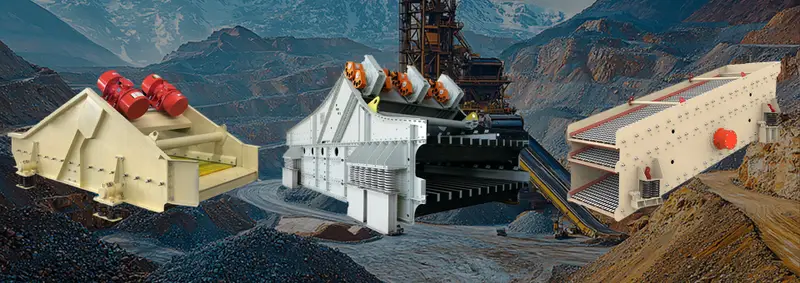
Linear vibrating screens are indispensable equipment in the mineral processing industry, playing a critical role in the beneficiation of copper and gold ores. As high-efficiency screening machines, they separate materials by particle size through linear vibratory motion, enabling accurate classification, dewatering, and impurity removal–-6. In large-scale copper and gold mining operations, these screens are essential for optimizing downstream processes, enhancing recovery rates, and ensuring product quality–.
Working Principle and Design Features
A linear vibrating screen is driven by dual vibrating motors or exciters that rotate synchronously in opposite directions-6. The resulting exciting force cancels out in the direction parallel to the motor axis while combining perpendicular to it, causing the screen box to move in a straight-line trajectory-6. Material fed onto the screen surface is thrown upward and propelled forward in a linear motion, allowing particles to be stratified and separated according to size as they pass over the screening deck-6. Multi-layer configurations enable simultaneous classification into two, three, or more size fractions within a single unit–.
Modern linear screens are built with robust mining-grade construction to withstand the harsh conditions of ore processing. Features include heavy-duty screen frames, wear-resistant components such as Hardox liners, rubber-coated side walls, and polyurethane or wedge wire screen decks-11-6. These design elements ensure longevity and reliable performance even when handling high-tonnage feeds.
Role in Copper Ore Processing
In copper mining, linear vibrating screens are employed at multiple stages of the beneficiation circuit. They are commonly used for pre-screening ahead of crushers, classification after grinding, and dewatering of final concentrates and tailings–. The ability to accurately separate particles by size is crucial for optimizing grinding circuit efficiency—replacing hydrocyclones with linear screens in milling circuits has been shown to reduce overgrinding, decrease mineral hold-up, and significantly increase mill capacities–.
Large copper mines often process massive throughputs. For example, Schenck Process designed its largest double-deck linear vibrating screen—the SLK4390WX—specifically for wet processing of high-throughput ore slurry from semi-autogenous (SAG) mills, handling 6,000 tonnes of solids per hour-2. In parallel operating lines, numerous such screens are used to extract thousands of tonnes of copper, gold, and molybdenum-2. This massive machine, measuring approximately 5.5 meters in width and 10.5 meters in length, features twin 90 kW motors and four exciters generating power comparable to four aircraft engines-2.
At KGHM Polska Miedź S.A., Poland’s world-leading copper producer, IFE linear vibrating screens replaced outdated equipment to meet growing quality and production demands-11. These screens process 1,200 tonnes of copper ore per hour, with a specially curved banana screen deck that improves material flow and enhances screening efficiency-11. The upper deck, equipped with robust wedge wire screens, protects the lower polyurethane deck from ore lumps up to 600 mm in size, while the lower deck separates material at 30 mm-11.
Role in Gold Ore Processing
In gold mining, linear screens serve equally vital functions. They are widely used for classification of milled gold ores, dewatering of tailings, and removal of tramp oversize material that could damage downstream equipment-6–. The DELKOR Belt Linear Screen, a specialized vibration-free linear screening system, was developed specifically to solve a major problem in carbon-in-pulp (CIP) gold plants: the removal of wood fiber and tramp oversize from milled gold slurries-27. Capable of screening between 150 and 2,000 microns, these units remove over 98% of wood fiber and tramp oversize—far exceeding the 40–70% removal rates of conventional systems-27.
At the Hidden Valley Gold Mine in Papua New Guinea, a DELKOR Belt Linear Screen has proven exceptional in handling large flow surges and excess coarse particles during cyclone roping-33. By preventing tramp oversize material from entering the downstream flotation, CIL, and elution circuits, the screen significantly reduces reagent consumption—including frother, promoter, collector, and copper sulphate—while protecting sensitive downstream equipment-33. The screen operates without vibration, ensuring complete retention of all oversize material-33.
Linear vibrating screens are also extensively used for dewatering gold and copper tailings, recovering valuable water and facilitating environmentally responsible tailings storage-6–. The tailings linear vibrating screen, for instance, is specifically designed for dehydration of copper ore, gold ore, and other mineral tailings, featuring high working frequency, strong vibration intensity, and high solid recovery-6.
Operational and Economic Advantages
Linear vibrating screens offer numerous benefits that make them ideal for copper and gold processing. They provide high screening efficiency with separation accuracy typically reaching 92–97%-38. Their simple structure, low energy consumption, and easy maintenance contribute to lower operating costs––. Many modern screens achieve availabilities up to 99%, minimizing costly downtime-27. Quick screen cloth change times—as little as 20 to 30 minutes—further reduce production interruptions-27. In a Chilean copper mine, optimized screen media combinations achieved a 23% energy reduction while processing 18 million tonnes per annum at 94% efficiency-38.
Conclusion
Linear vibrating screens are fundamental to modern copper and gold ore processing. From handling 10,000 tonnes per hour of ore slurry in large-scale copper operations to removing tramp oversize with 98% efficiency in gold CIP circuits, these machines enable precise classification, protect downstream equipment, and enhance overall plant productivity. Their robust construction, high efficiency, and low maintenance requirements make them indispensable assets in the mining industry’s quest to extract valuable metals economically and sustainably.