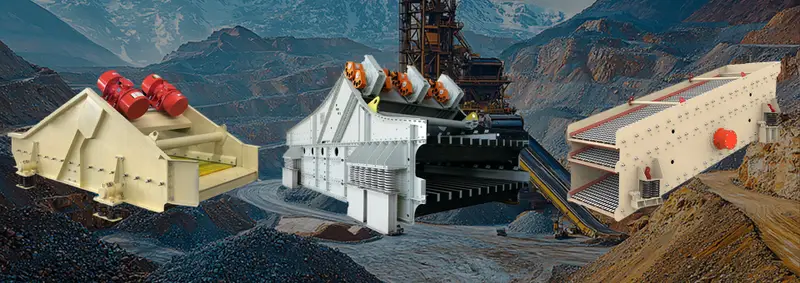
Here are the key advantages of using a vibrating screen, broken down by how they improve efficiency, product quality, and operational costs.
1. High Screening Efficiency
Vibrating screens are exceptionally good at separating particles quickly and accurately.
-
Rapid Stratification: The high-frequency vibration causes larger particles to rise to the top and smaller particles to sink to the bottom, allowing them to pass through the mesh faster.
-
Reduced Blinding: The vibratory motion helps shake loose particles that might otherwise get stuck (blind) in the mesh openings, maintaining consistent throughput.
2. Wide Range of Applications
Unlike static screens, vibrating screens are highly versatile.
-
Material Variety: They can handle everything from dry, fine powders (like cement or flour) to wet, coarse aggregates (like gravel or coal) and even slurries (dewatering).
-
Multiple Cuts: A single machine can be built with multiple decks (e.g., 3 or 4 layers of mesh) to sort material into 4 or 5 different sized fractions at once.
3. High Throughput Capacity
For the same footprint, a vibrating screen moves material across the mesh much faster than a static or trommel screen. This makes it ideal for high-volume industries like mining and bulk material processing where tons per hour are critical.
4. Compact and Versatile Design
-
Space Saving: They have a relatively small footprint compared to their screening area, especially linear or circular motion screens.
-
Configurable Angle: The angle of the screen deck can often be adjusted to control the speed of material flow (e.g., slower for finer cuts, faster for high volume).
5. Low Maintenance & Long Life
-
Simple Drive Mechanism: Most use robust, eccentric drive systems or gearboxes with few moving parts.
-
Durable Construction: They are typically built with heavy-duty steel and use modular, replaceable screen panels (polyurethane, wire mesh, or perforated plate) that are easy to swap out.
6. Energy Efficient
Compared to rotating screens (trommels) or air classifiers, vibrating screens use relatively low energy. The electric motor only needs to power the vibrator mechanism, not lift or throw the entire load of material continuously.
7. Positive Material Travel
On inclined vibrating screens, gravity and vibration work together to ensure material moves steadily across the deck. This eliminates the need for powered conveyor belts or pushers within the screen itself.
8. Can Handle Wet or Sticky Materials
While no screen handles wet clay perfectly, vibrating screens perform better than static ones. The aggressive vibration helps break up surface tension and agglomerates, allowing moisture-laden materials to be screened with less clogging (especially when using self-cleaning mesh or rubber balls).
Summary Comparison
| Feature | Vibrating Screen Advantage | vs. Static/Trommel Screen |
|---|---|---|
| Speed | Very fast separation | Static = slow; Trommel = slower |
| Blinding | Vibration self-cleans mesh | Frequent clogging & downtime |
| Footprint | High area per square foot | Trommel needs much more space |
| Maintenance | Simple drive, replaceable panels | More complex bearings or structure |
| Multi-sizing | Easy (multiple decks) | Difficult on trommel; impossible on static |
When to Choose a Different Screen?
Despite these advantages, vibrating screens aren’t perfect for every job. You might not use one if:
-
You need to screen ultra-fine particles (<50 microns) – an ultrasonic or air classifier is better.
-
The material is highly abrasive and round (e.g., steel shot) – it will wear out mesh too fast.
-
Noise is a critical issue – vibrating screens are loud.