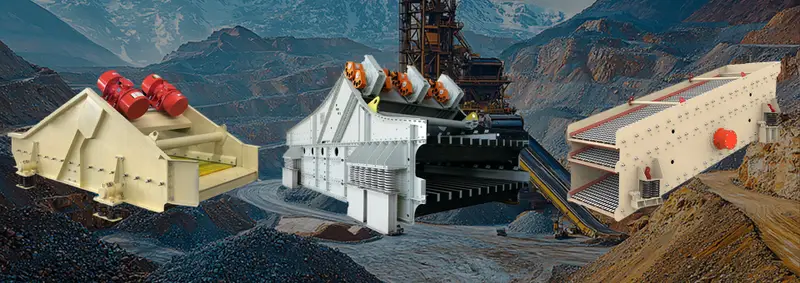
Grizzly screens and vibrating screens serve distinct purposes in material processing, with key differences in design, functionality, and applications:
Design & Construction
Grizzly screens consist of rigid parallel bars arranged in a tapered grid, creating progressively wider gaps to prevent jamming. They often include liners for wear protection and lack moving parts aside from the vibrating feeder mechanism.
Vibrating screens employ a multi-layered mesh screen mounted on a vibrating frame driven by an eccentric shaft or exciter, enabling material stratification and segregation through controlled vibration.
Primary Function
Grizzly screens are primarily used for coarse separation of oversized material (e.g., rocks, chunks) from finer particles, often installed above crushers or silos to protect downstream equipment.
Vibrating screens focus on precise classification by size, separating materials into multiple grades (e.g., 0.045mm to 100mm) through vibration-induced particle movement.
Applications
Grizzlies are common in primary crushing stages (e.g., mining, construction) for initial sizing and removal of large debris.
Vibrating screens are versatile across secondary/tertiary processing (e.g., mineral sorting, dewatering, chemical/powder grading) due to adjustable mesh sizes and configurations.
Mechanical Action
Grizzlies rely on static bar separation with optional vibration for feeding, limiting their screening efficiency compared to vibrating screens.
Vibrating screens use dynamic oscillation to enhance material flow and stratification, enabling higher throughput (up to 1000 TPH) and finer separations.
In summary, grizzlies act as protective pre-screeners, while vibrating screens perform detailed grading. Their complementary roles often appear in sequential material handling systems.