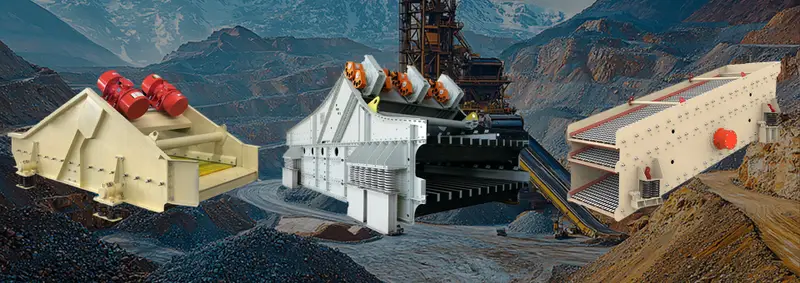
A vibrating screen is a mechanical separation device that uses controlled vibrations to sort and classify materials by particle size. It consists of a screen surface (mesh or perforated plate) mounted on a vibrating frame, which shakes or oscillates to facilitate the movement and separation of particles.
How It Works
-
Vibration Mechanism
- Driven by eccentric weights, electromagnetic exciters, or unbalanced motors, the screen generates high-frequency oscillations (typically 800–3600 RPM).
- The motion can be linear, circular, or elliptical, depending on the design.
-
Material Separation
- Feed material is introduced onto the screen surface.
- Smaller particles pass through the mesh (undersize), while larger particles travel across and exit separately (oversize).
- Multiple decks (layers) allow for multi-stage classification (e.g., coarse, medium, fine).
Key Components
| Component | Function |
|---|---|
| Screen Mesh | Determines cut-off size (e.g., 0.1–100mm) |
| Vibration Motor/Exciter | Generates oscillatory force |
| Springs/Dampers | Absorb shock and stabilize motion |
| Screen Frame | Supports the structure and material flow |
Types of Vibrating Screens
- Linear Vibrating Screen – Straight-line motion for precise grading (common in aggregates).
- Circular Vibrating Screen – Rotary motion for high-capacity screening (used in mining).
- High-Frequency Screen – Ultrasonic vibrations for fine powders (e.g., silica sand).
- Banana Screen – Multi-slope design for sticky materials (coal processing).
Applications
✔ Mining & Quarrying – Ore, coal, gravel classification
✔ Recycling – Plastic, metal, and waste sorting
✔ Food & Pharma – Sugar, flour, powder sieving
✔ Chemical Industry – Fertilizer, resin, and chemical separation
Advantages
- High efficiency (up to 95% separation accuracy)
- Low maintenance (few moving parts)
- Customizable (mesh size, deck layers, vibration pattern)