
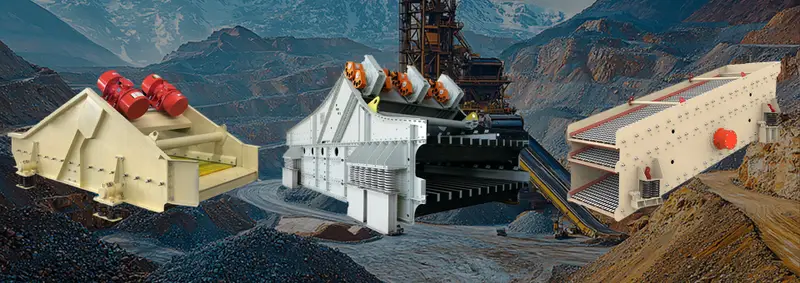
Vibrating screen mesh is the key component of a vibrating screen that separates materials by size through mechanical vibration. It’s typically made of materials like stainless steel, polyurethane, or manganese steel, and comes in various mesh sizes (e.g., 4–500 mesh) to suit different applications.
Applications
- Mining & Quarrying: Separates ores and aggregates.
- Food & Pharmaceuticals: Grades powders and granules.
- Waste Management: Sorts recyclables and removes contaminants.
Types of Meshes
- Linear Vibrating Screens: Use dual motors for straight-line motion.
- Circular Vibrating Screens: Employ circular motion for high-capacity screening.
- Ultrasonic Vibrating Screens: Use high-frequency vibrations for fine powder screening.
Key Features
- Durability: Resistant to corrosion and wear.
- Customization: Available in various mesh sizes and materials.
- Efficiency: High-power ultrasonic options enable rapid and precise screening.
Key Functions
- Particle Size Separation: Sorts materials into fine, medium, or coarse fractions.
- Material Classification: Ensures uniformity in industries like mining, food, and pharmaceuticals.
Common Materials
- Stainless Steel: Durable, corrosion-resistant (e.g., SS304, SS316).
- Polyurethane: Resistant to clogging and wear.
- Manganese Steel: High tensile strength for heavy-duty use.
Global Supply
In summary, vibrating screen mesh is essential for efficient material separation, classification, and purification across various industries, enhancing productivity and product quality.