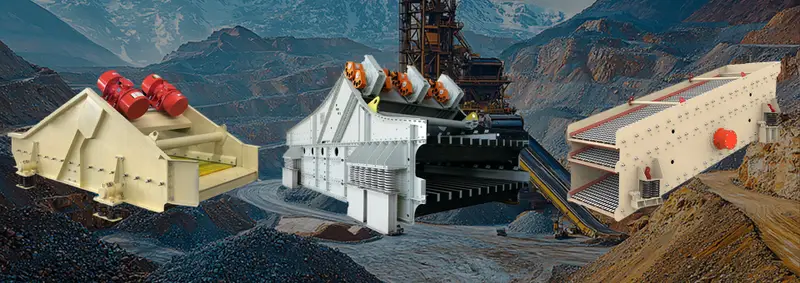
Vibrating screens (also called vibratory sieves or separators) work by using controlled vibration to separate, classify, and convey bulk materials (like aggregates, grains, powders, or minerals) based on particle size. Here’s a step-by-step breakdown of their operation:
Core Working Principle
-
Vibration Generation:
- An electric motor drives an eccentric shaft (or unbalanced weights/rotors) attached to the screen frame.
- As the shaft rotates, centrifugal force creates high-frequency oscillations (typically 600–3,600 RPM).
-
Material Movement:
- Material fed onto the screen deck is subjected to rapid vertical and horizontal vibrations.
- This causes particles to:
- Fluidize: Smaller particles sink.
- Stratify: Larger particles rise to the top.
- Convey: Move forward due to the screen’s slight downward inclination (usually 15°–30°).
-
Separation Process:
- Undersize particles (< mesh size) fall through the screen apertures.
- Oversize particles (> mesh size) travel along the deck and exit via a separate outlet.
Key Components & Their Roles
| Component | Function |
|---|---|
| Screen Deck | Mesh/surface with precise apertures; determines separation size. |
| Vibrator Assembly | Generates motion via eccentric weights, electromagnetic pulses, or motors. |
| Springs/Suspension | Isolate vibration, absorb shocks, and allow free oscillation. |
| Screen Frame | Supports the deck and vibratory mechanism. |
| Drive Unit | Powers the vibration (e.g., electric motor with unbalanced masses). |
Types of Vibration Motion
-
Circular Vibration:
- Eccentric weights rotate to create a circular motion.
- Best for coarse screening (e.g., aggregates in mining).
- High conveyance speed, moderate stratification.
-
Linear Vibration:
- Twin counter-rotating motors create straight-line oscillation.
- Ideal for fine screening/dewatering (e.g., sand, chemicals).
- Better particle stratification, slower material flow.
-
Elliptical Vibration:
- Hybrid of circular/linear motion; adjusts based on deck position.
- Used for sticky or wet materials (e.g., clay, food products).
-
High-Frequency Vibration:
- Electromagnetic or ultrasonic vibrators (for ultra-fine powders).
- Prevents blinding (clogging) of mesh.
Critical Factors Affecting Efficiency
- Amplitude: Vertical displacement of the deck (1–10 mm). Higher = coarser separation.
- Frequency: Vibrations per minute (900–3,600 RPM). Higher = finer separation.
- Screen Angle: Tilt of the deck. Steeper = faster flow, shorter residence time.
- Mesh Design: Aperture shape/size (square, slot, polyurethane).
- Material Load: Overfeeding reduces accuracy; underfeeding lowers throughput.
Real-World Applications
- Mining/Quarrying: Sorting crushed stones (e.g., F1 screens handle high-impact loads).
- Agriculture: Grading grains, seeds, or fertilizers.
- Recycling: Separating plastics/metals from waste.
- Food Processing: Sifting flour, sugar, or spices.
- Pharmaceuticals: Ensuring powder consistency in tablets.
Advantages vs. Limitations
| Pros | Cons |
|---|---|
| High throughput (up to 1,000 t/h) | Noise/vibration require isolation |
| Adaptable to wet/dry materials | Mesh wear & blinding risk |
| Minimal manual intervention | Complex maintenance (bearings) |
| Multi-deck designs for grading | Energy-intensive operation |
Why Vibration Works
The vibration overcomes friction and cohesion between particles, allowing smaller grains to slip through the mesh while larger ones “walk” across the deck. Adjusting amplitude/frequency tailors the screen to specific materials—like optimizing an F3 formwork for high-pressure concrete.
💡 Pro Tip: Pair vibrating screens with grizzlies (coarse pre-screens) to boost efficiency and protect fine mesh from damage!